
Barry County Parole and Probation
Parole and probation both involve rules in the community, but they begin in different ways. Parole follows an MDOC prison term. The Michigan Parole Board authorizes it, and the person remains under Michigan Department of Corrections jurisdiction after leaving prison. Probation is ordered by a court. It can follow a jail term or serve as an alternative to confinement. OTIS covers MDOC-supervised felony probation, but it does not promise a record for every local or jail-only case.
Neither status is a Barry County Jail roster category. A person missing from a county custody result could have bonded out, completed a jail term, transferred, or entered another custody system. That absence does not establish parole or probation. A current OTIS entry and, when needed, the Barry County Parole/Probation Office provide the right state-supervision path.
| Record point | Parole | Probation |
|---|---|---|
| How it begins | Release from an MDOC prison after Board action and release processing | Court order that may follow or replace confinement |
| Public OTIS status | PAROLE | PROB for MDOC-supervised probation |
| Physical custody | Out of prison, still under MDOC jurisdiction | Usually in the community under a court order |
| End point | Discharge from MDOC jurisdiction | Completion or discharge under the governing order |
Verify Barry County Post-Release Supervision
The Michigan OTIS search is the main public lookup for MDOC prisoners, parolees, probationers, absconders, and people discharged within its public window. Search by the six-digit MDOC number when known. A last name also works, with optional age, race, gender, and status refiners. Match more than a name before relying on a result.
- Search OTIS by MDOC number or at least the last name.
- Open the matching record and read the current status code.
- Check the location. For community supervision, it identifies the supervision area rather than a prison cell.
- For parole, read
DATE PAROLED. Do not treat the Parole Board Jurisdiction Date as an actual release. - Look for
DISCHRGwhen the question is whether MDOC jurisdiction has ended. - Call the Barry County field office when a current local supervision fact needs confirmation or correction.
When the record shows PRISON, the person remains in MDOC custody. PAROLE means release into supervision has begun, while PROB identifies MDOC-supervised probation. A displayed Barry County location names the supervision area. It does not mean the person is held at the county jail or lives at the office address.
Barry County Supervision Office Contact
The local office belongs to MDOC Field Operations Region 4. It is the appropriate contact when OTIS places current supervision in Barry County or when a displayed supervision fact may be wrong. Staff may confirm public routing information, but protected case-management facts are not necessarily available to a caller.
Barry County Parole/Probation Office206 W. Court Street, Courts & Law Building #102
Hastings, MI 49058
269-945-1389
The MDOC Region 4 office directory is the source for this Barry County supervision contact. The captured directory view below helps confirm that the office is part of the state field-operations system.
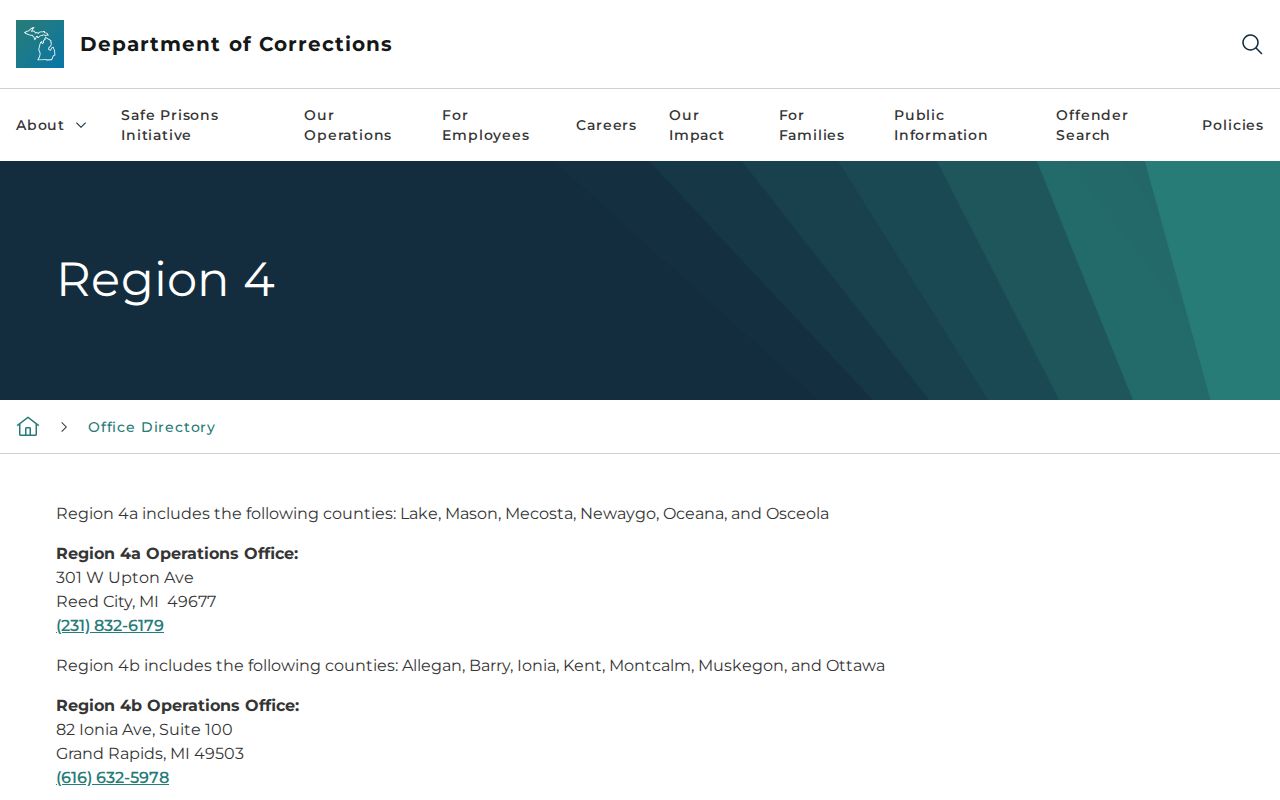
Use the directory and OTIS together: OTIS supplies the person-level public status, while the directory supplies the local office route.
Note: The office contact does not turn an eligibility date or Board grant into proof that physical release occurred.
Barry County Parole Release Proof
The Michigan Parole Board is the sole paroling authority for felony offenders committed to MDOC. Under MCL 791.233, the Board considers whether release can occur without making the person a menace to society or public safety. MCL 791.234 establishes when the Board gains jurisdiction after the applicable minimum term. Eligibility means the Board may consider parole. It does not mean release has happened.
A Board decision can grant, deny, or defer parole. A positive decision starts more work. The Parole Release Unit documents the parole date, term, and special conditions, and it coordinates a placement. Release arrangements, a detainer, or another administrative step may still delay departure. For a public record check, DATE PAROLED and PAROLE in OTIS are stronger evidence that parole status began than a jurisdiction date or hearing notice.
Michigan does not publish a person-by-person database of all parole decisions apart from the status shown in OTIS. Public special or lifer hearing notices appear on a registration calendar, and aggregate reports count grants, denials, and deferrals. An individual decision or notice may be requested through MDOC FOIA when a durable record is needed.
Ordinary prisoner parole interviews do not appear on a complete statewide public calendar. Michigan posts a Public Hearing Registration page for public special or lifer parole and clemency matters. Those notices usually identify the person, hearing date and time, and remote access details, and registration is required by the stated deadline. A hearing listing remains notice of a proceeding, not proof of its result. After Board action and release processing, OTIS is still the public person-level source to check.
Barry County Absconder Status
An absconder is a person whom the supervising agency reports as having stopped complying with required contact or location rules. OTIS uses ABSCOND1 for a parole absconder and ABSCOND2 for a probation absconder. These are supervision statuses. They do not mean the person completed supervision simply because the person is no longer in a jail or at the last known address.
Read the full OTIS record, including status and location. The location may show the last supervising place rather than the person’s present location. A warrant or enforcement action is also distinct from a past release event. MDOC directs people who have location information about an absconder or escapee to local law enforcement or its Absconder/Escapee Tip Line at 517-755-0855. Do not use a county roster gap as a substitute for that state status.
- Parole
- Release from prison while MDOC supervision continues.
- Probation
- A court-ordered period of supervision that may follow or replace confinement.
- Absconder
- A supervision status showing loss of required contact or compliance.
- Discharge
- The end of MDOC jurisdiction for the displayed sentence.
Barry County Supervision and MI-VINE
MI-VINE and OTIS answer different questions. MI-VINE provides custody and court-event information and can send notifications for events reported by a participating agency. Barry County’s official inmate-lookup page directs users to VINELink, but statewide material qualifies county participation. An Out of Custody result ends only the reporting agency’s custody. It does not establish parole, probation, or discharge.
For an MDOC prisoner, Michigan materials direct victim-notification registration through MDOC Crime Victim Services at 877-886-5401. Phone, text, and email methods may be available. OTIS remains the public route for status, supervision location, Date Paroled, and discharge. The two systems can support one another, but neither should be stretched beyond the agency and event shown.
Telephone VINE registration uses a four-digit PIN. When an automated call arrives, entering the PIN and pound key confirms the message. Without that confirmation, repeat calls may continue for up to 72 hours. That period concerns delivery attempts, not a Barry County release-list window and not the length of supervision. Email and text alerts generally send one event message and do not use the phone PIN.
Note: A custody alert can confirm an event, while OTIS is the better public source for ongoing MDOC supervision status.
Barry County Release and Reentry Programs
Barry County’s local reentry landscape begins before release. The jail’s Inmate Programs page lists Earned Early Release, jail diversion, mental-health and recovery services, cognitive programs, educational work, and court-ordered work release. These programs may support a transition or satisfy part of a court plan. Their existence does not establish that a specific person qualified, earned an earlier date, or left custody.
Reach the Forgotten Jail Ministry provides mentoring, recovery classes, and links to reentry services. Barry County chaplain hours are published for Tuesday and Thursday from 9:00 a.m. to noon. A program record can explain support that was offered, but the release event still requires the court order, jail record, or state status that applies to the person.
This distinction matters for supervision. A person may complete jail programming and then begin probation, transfer to MDOC, or return to the community without MDOC supervision. Another person may leave state prison on parole and report to the Barry County office. Programs describe services. They do not replace the official custody and supervision records.
Earned Early Release is a named jail program, not an OTIS status code. Court-ordered work release also differs from state parole because the person remains tied to the county court and jail arrangement. When the release basis is unclear, the 56-B District Court docket and Sheriff release record can identify the local event. OTIS becomes relevant only if MDOC custody or supervision actually applies.
Barry County Supervision Discharge
Parole and probation end through the terms of the controlling state or court process, not through silence in a jail search. In OTIS, DISCHRG means MDOC no longer has jurisdiction for the displayed sentence. It differs from PAROLE, which still carries supervision. A person may also have an unrelated case, warrant, or custody event, so the status must be read within its record.
OTIS generally displays a person for three years after the latest MDOC supervision discharge. Older state records may require MDOC Records Retention or the Archives of Michigan. Set-aside convictions are removed from public OTIS. Thus, a missing record can reflect the public time window, a set-aside, or the fact that the case never entered MDOC. The broader county release and record paths are covered on the Barry County released inmates home page.
If an OTIS fact is inaccurate, court-derived errors go first to the sentencing court. Supervision-status errors should go to the agent or field office. MDOC also lists correctionsinfo@michigan.gov for inaccurate, incomplete, or outdated public information. Keep the correction route tied to the source of the disputed fact.