
Barry County Release Date Meanings
A scheduled or projected release date is a calculation based on the record as it stands. It can be useful for planning, but it is not proof that the person has left. An actual release date records an event that occurred. In the Michigan prison system, the public fields have specific names, and none should be replaced with a vague estimate.
Custody type controls the meaning. A person awaiting trial at Barry County Jail may have a bond amount or future court date without a set release date. A person serving a county-jail sentence has a calculation based on the court commitment and jail records. A person committed to MDOC has an indeterminate prison sentence with state fields for parole jurisdiction, parole, and maximum discharge. A federal prisoner uses the BOP system, not OTIS.
- Projected date
- A date calculated from current sentence and custody information that may still change.
- Parole
- Release from prison into community supervision while MDOC jurisdiction continues.
- Discharge
- The end of MDOC jurisdiction for the displayed sentence.
- Detainer
- A request or legal hold that may send the person to another authority instead of the community.
Find Barry County Inmate Release Dates
Start by identifying the custodian. Barry County Jail, MDOC, and BOP do not share one release-date field. The county jail handles local detainees and jail sentences. MDOC handles people committed to Michigan prison and community supervision. BOP covers federal prison custody. A move from the Barry County Jail to any of those other custodians is a transfer, even though the person has left the county building.
- Confirm whether the person is in Barry County Jail, MDOC, or federal custody.
- For a jail detainee, review the court docket for bond, disposition, sentence, or commitment activity.
- Call Barry County Jail for current status and the recorded jail release computation.
- For an MDOC prisoner, search OTIS by the six-digit number or last name.
- Read status, Parole Board Jurisdiction Date, Maximum Date, and Date Paroled together.
- Use BOP’s locator for a federal sentence and its agency-specific release date.
- Confirm the completed event with the release record or the agency’s actual-release field.
The Barry County release-record workflow adds the right docket and document request when a public screen is not enough. For a local case, all adult criminal proceedings begin in the 56-B District Court search. A felony may move to the 5th Circuit Court search after bindover. Search both courts when the District docket appears to stop. Court entries show legal authority, while the jail record can establish the physical exit time or transfer destination.
Barry County OTIS Release Dates
The MDOC Offender Tracking Information System is the main public route for a Michigan state prisoner. It covers current prisoners, parolees, probationers, absconders, and people discharged within three years of their latest supervision discharge. OTIS expressly excludes people held only in county jails or city lockups and those sentenced only to jail. A Barry County Jail date cannot be found by forcing a jail-only case into the state search.
| OTIS field | Meaning for release |
|---|---|
| Parole Board Jurisdiction Date | The earliest release date, or ERD, when the Board first has authority to consider parole. |
| Date Paroled | The date the person left prison or otherwise acquired parole status. |
| Maximum Date | The sentence endpoint by which discharge must occur if parole does not happen earlier, subject to eligible legacy credit rules. |
| Status: PRISON | The person remains in MDOC prison custody. |
| Status: PAROLE | The person is out of prison but still under MDOC supervision. |
| Status: DISCHRG | MDOC jurisdiction ended for the displayed sentence. |
The ERD is not an appointment for release. The Board may grant, deny, or defer parole after jurisdiction begins. A positive decision also starts work by the Parole Release Unit on the date, term, conditions, and placement. Administrative or placement steps may remain. Read Date Paroled and current status after processing rather than treating an eligible date or Board action as completed release.
The MDOC Parole Release Unit page shows how a positive decision moves into documented release planning.
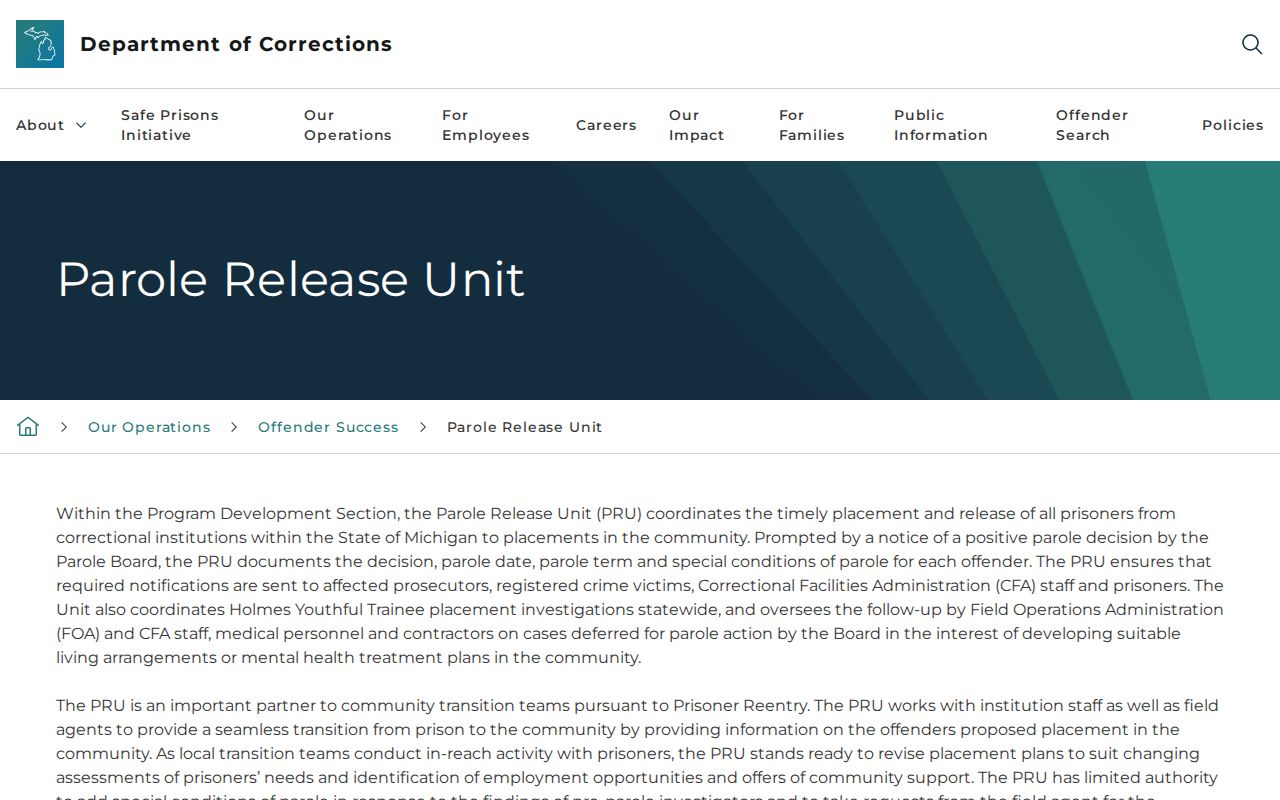
This state process explains why a parole grant and a physical departure can occur at different points in the record.
Michigan Sentencing Shapes Barry Releases
Michigan generally uses indeterminate prison sentences with a minimum and a maximum. The minimum controls when Parole Board jurisdiction begins. The maximum limits how long MDOC may imprison the person for the controlling sentence. The Board may authorize parole between those points when the statutory and case requirements are met, but it may also deny release until a later review or until maximum discharge.
MCL 791.234 governs Parole Board jurisdiction and sentence aggregation. Consecutive terms may be combined. Therefore, one charge or one minimum term on a court screen does not provide enough information to calculate release. The Judgment of Sentence, jail credit, offense date, concurrent or consecutive structure, and MDOC computation all affect the displayed state dates.
Barry County readers should also separate the sentencing court from the custodian. The 5th Circuit Court may impose an MDOC sentence, but MDOC computes and tracks the prison dates. Leaving the county jail for state intake is not parole. OTIS later shows the prison placement and state fields, regardless of which Michigan institution houses the person.
Note: A court sentence supplies legal terms, while MDOC applies the controlling sentence structure and displays the state release fields.
Barry Release Dates and Credits
Michigan does not have a sound rule that every prisoner serves about 85 percent. That shortcut is wrong for Barry County release-date work. Under truth in sentencing, affected prisoners must serve the full judicial minimum in prison before parole consideration. MDOC states that the framework covers assaultive offenses committed on or after December 15, 1998 and other offenses committed on or after December 15, 2000.
Those truth-in-sentencing cohorts cannot shorten the minimum with good-time or disciplinary credits. Misconduct can produce disciplinary time that the Parole Board considers. MCL 800.34 supplies the relevant disciplinary-time framework. The result is not a fixed percentage. It is a sentence-specific minimum followed by the parole process.
Older offense-date cohorts can fall under legacy systems. Good time generally applies to crimes committed before April 1, 1987. Eligible offenses committed from that date until the applicable truth-in-sentencing cutoff may receive disciplinary credits under MCL 800.33, generally five days per month plus possible special credit. Major misconduct can cause eligible credits to be lost or forfeited. Never subtract a standard share from the court sentence.
Barry County Jail Release Dates
A person held before trial has no computed sentence-completion date. Release may depend on posting bond, a recognizance order, dismissal, a new court order, or the resolution of another hold. A bond amount on the docket is not proof that all conditions were met or that the person walked out. Confirm the event with the Barry County Jail or the release record.
For a sentenced county-jail inmate, use the court commitment and ask the jail about the recorded computation. The official Barry County Jail page does not publish a general jail good-time formula, weekend-release rule, or public projected-date field. The county also does not publish a native roster or recent-release archive. A precise county date therefore comes from the jail and Sheriff record rather than OTIS.
1212 W. State Street
Hastings, MI 49058
269-948-4804
When the court commits the person to MDOC, the county departure is a transfer. Move the search to OTIS after state intake. If a detainer sends the person to another county, federal authority, or immigration custody, use that receiving system. The distinction keeps a county exit from being mislabeled as community release.
Why Barry Release Dates Change
A projected date is based on the information then accepted by the court and custodian. Later legal action or corrections processing can move it. The direction of change depends on the record. A corrected jail-credit entry might alter the computation, while an unresolved detainer may prevent community release even when one agency’s sentence reaches an endpoint.
| Factor | Possible effect | Best confirmation |
|---|---|---|
| Corrected judgment or jail credit | Changes the controlling sentence computation | Sentencing court and updated MDOC or jail record |
| Consecutive sentences | Extends the combined minimum or maximum calculation | Judgment of Sentence and OTIS fields |
| Legacy credit loss | Moves an eligible older-sentence calculation | MDOC computation |
| Parole denial or deferral | Leaves the person in prison beyond the first jurisdiction date | Current OTIS status and later review information |
| Detainer or hold | Causes transfer instead of community release | Releasing and receiving agencies |
| Incomplete release plan | Delays physical departure after favorable Board action | MDOC release processing and Date Paroled |
A Parole Board Jurisdiction Date can pass while status remains PRISON. That is not a database contradiction. It means the eligibility point did not become parole. Likewise, a favorable Board decision can precede the completed exit because placement and release steps still need to occur.
Confirm Barry County Release Dates
For a Barry County Jail event, use VINELink as the county-designated online check, then call the jail and read the proper court docket. Request the Sheriff booking and release record when an exact timestamp, release type, or transfer destination is needed. The Barry County VINELink release check explains the person search and alert registration without treating an alert as the source release record.
For a state prisoner, compare OTIS status with Date Paroled, Parole Board Jurisdiction Date, and Maximum Date. PAROLE plus Date Paroled supports release into supervision. DISCHRG means MDOC jurisdiction ended for that sentence. OTIS keeps ordinary discharged records online for three years after the latest supervision discharge, subject to set-aside removal. Older state proof may require MDOC Records Retention, FOIA, or Archives.
For federal prison, the BOP Inmate Locator may display a release date and Released or Not in BOP Custody. It confirms only the end of BOP custody and does not rule out a state transfer, immigration detainer, or federal supervised release. ICE has a separate recent-custody locator. An agency release date must remain tied to that agency.
Actual departure is the final check. Use Date Paroled for MDOC parole, a Sheriff release record for the Barry County Jail, or the corresponding federal document. A projected date alone cannot prove the event occurred.